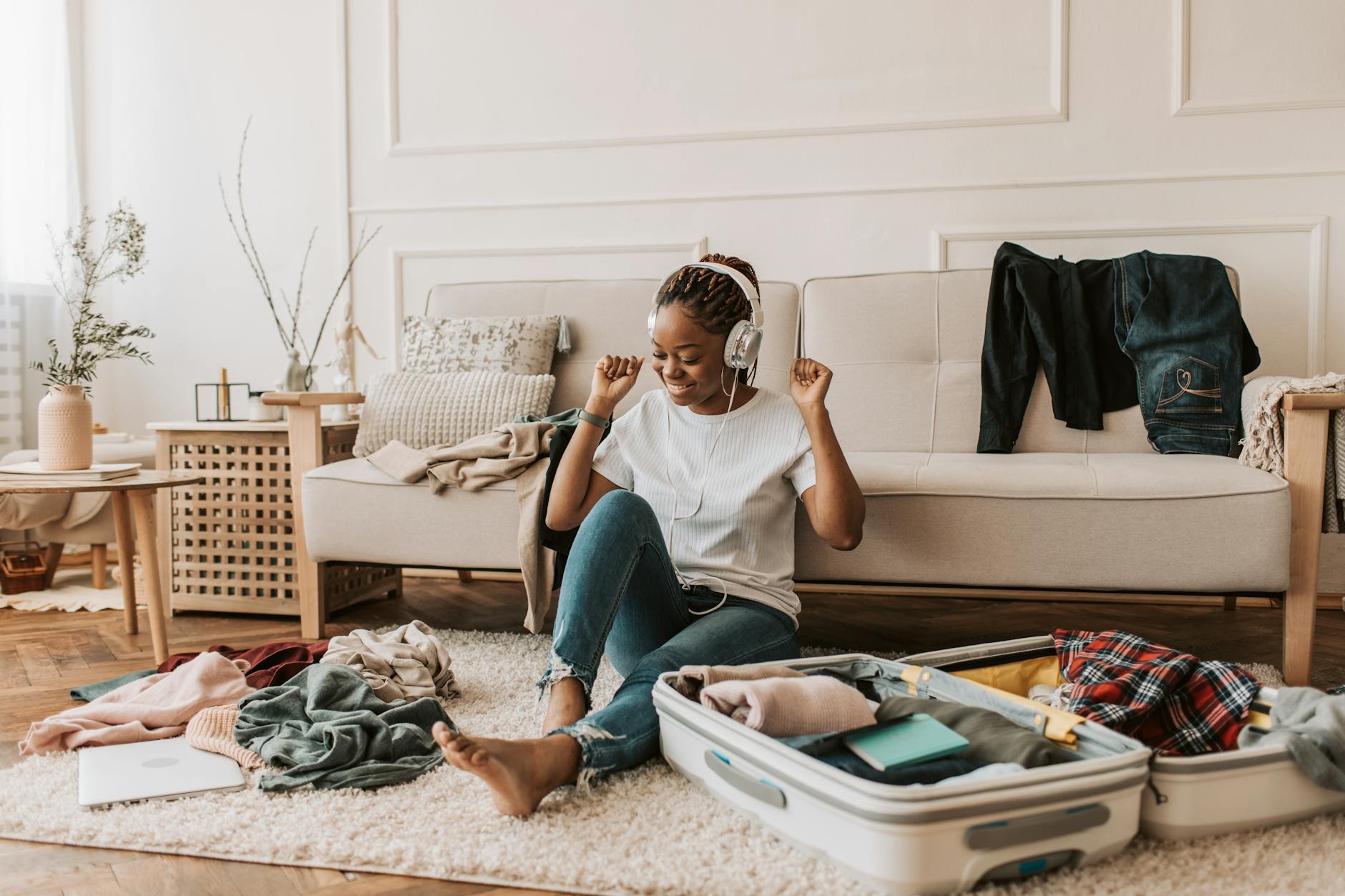
You cannot learn quantum mechanics while folding laundry. Try it: queue up a lecture on the Schrödinger equation, start matching socks, and at the end you will have a tidy drawer and almost nothing in your head. But that same laundry hour can absorb a surprising amount of other material — a magazine feature, a chapter of narrative history, a re-listen of an article you already half-understand. The trick is not getting better at listening. The trick is knowing which is which.
This is where most "learn while you commute" advice falls apart. It treats audio as a universal upgrade, a way to convert dead time into study time no matter what you feed it. Cognitive science says that is wrong. Audio learning is a tool with a shape, and when you match the material to the shape it works well. When you don't, you get the laundry-and-Schrödinger result: motion without memory.
What listening actually costs your brain
Start with the thing nobody mentions: reading and listening are not the same cognitive act, even when the words are identical.
When you read, your eyes control the pace. You can stop on a hard sentence, back up, reread the clause you skimmed, and sit on a diagram until it clicks. That control is doing quiet, heavy lifting. Audio takes it away. The narration moves at a fixed speed and the next sentence arrives whether or not you finished the last one. For easy material that is no loss. For dense material it is the whole ballgame, because the hard part of understanding a tight argument is holding a claim in working memory long enough to weigh the qualification that comes after it — and audio gives you no beat to do that in.
Cognitive load theory, the framework John Sweller laid out in the late 1980s, names the constraint directly: working memory is small and easily swamped. When intrinsic difficulty (the material itself) plus the effort of just keeping up exceeds what working memory can hold, comprehension collapses. Reading lets you regulate that load by pausing. Listening, by default, does not.
So the first rule writes itself: audio is fine right up until the material demands the pauses that audio removes.
Where audio quietly wins
Now the good news, because it is genuinely good. There is a real cognitive reason audio can match or beat reading for the right content.
Dual-coding theory, from Allan Paivio in the 1970s, holds that we encode information through two partly separate channels — verbal and visual. Most text leans entirely on the verbal channel. Audio also lives in the verbal channel, but it frees the visual channel for whatever you are looking at — the road, the trail, the sink full of dishes. For low-stakes intake during a routine physical task, that division is a feature, not a bug. Your eyes and hands are busy with something automatic, and your verbal channel is free to take in a story.
And stories are the sweet spot. Narrative material — history, memoir, reported features, biography — is built to be heard. Humans absorbed narrative by ear for tens of thousands of years before writing existed. The structure carries you forward; each part sets up the next; there is little to hold in suspension. The same is true of review. Re-listening to an article you already read once is one of the most underrated uses of audio, because the structure is already in your head and the second pass just deepens the grooves — a low-load, high-return task that fits perfectly into a walk.
Where audio loses, honestly
It loses in two predictable places, and pretending otherwise just sets you up to forget things.
The first is dense technical material — anything with notation, nested logic, a chart you need to study, or vocabulary you are meeting for the first time. A proof, a statistics paper, an API reference, a chapter introducing twelve new terms in ten pages. This is the quantum-mechanics-and-laundry case. The material needs rereads and a stationary diagram, and a moving narration denies you both.
The second is anything that requires note-taking. The moment real learning depends on you writing, annotating, or working a problem, audio-while-busy stops being viable, because the "while busy" part is the problem. You cannot take notes with your hands in the dishwater. There is also the divided-attention cost: the more demanding your physical task, the less working memory is left for the audio. Folding laundry is nearly automatic, so it leaves plenty. Navigating heavy traffic or cooking something that can burn does not — which is why so much "I listened to the whole thing" intake evaporates the second the driving got interesting.
How to use a tool like this deliberately
None of this is an argument against audio. It is an argument for aiming it. Before you send something to your ears, run a two-second triage:
- Narrative, opinion, a feature, or a re-listen of something you already read? Send it to audio and enjoy the laundry hour. This is exactly what we built @OutloudAIBot for — you forward an article, a PDF, or a link, and it comes back as natural-sounding audio you can take on a walk.
- Dense, technical, full of notation, or something you'll need to annotate? Read it at a desk. If you still want the audio, treat it as a preview — a first low-stakes pass to get the lay of the land before you sit down and do the real work with your eyes and a pen.
That preview move is the one that actually changes outcomes. Listening to a hard piece once on a walk won't teach it to you, but it primes the structure so the careful read goes faster. Audio as the opening pass, reading as the closing pass.
The honest version of "learning on the go" is narrower than the slogan and far more useful. You won't master a hard subject between the bus stop and your front door. But the right material — narrative, review, low-stakes intake while your hands are busy — really does transfer, and the science says why. Match the medium to the material, stop asking your ears to do your eyes' job, and the laundry hour pays off.